AI and Digital Poverty: Bridging or Widening the Divide?
AI and Digital Poverty: Bridging or Widening the Divide?Artificial intelligence is transforming how people work, learn, and access digital services, but could AI deepen digital poverty in the UK? This article explores how AI could both reduce and widen digital exclusion. Why AI literacy is becoming an essential digital skill, and what government, public services, and technology leaders can do to ensure the benefits of AI are accessible to everyone.
Introduction
Ever since I read Terance Eden’s blog post “The unreasonable effectiveness of simple HTML”, the thought of how millions of citizens access government services in the UK has fascinated me. It really is one of those ultimately unknowable questions, no matter how much data you have, you will never fully understand why a user accesses the internet in the way they do.
Only when you actually get to speak to users can you fill in the additional context about their life and unique situation, and this is where Terance’s blog post really stands out. As it’s an actual account from a young woman at a housing benefits office in London. I won’t retell the story as it is so well written, I wouldn’t be able to do it justice, but a summarised version is:
The post describes a young woman sitting in a housing benefits office, surrounded by bags containing all her worldly possessions and seemingly in a difficult emotional situation. With a PlayStation Portable in her hands, she appeared at first to be playing a game, but was actually using its basic web browser to access the information and services she needed. Her situation is a powerful reminder that users of essential public services may be vulnerable, under pressure, and relying on old or unconventional technology simply because it is what they have available.
It was a real eye-opener to me when I first read it. I’d highly recommend reading it too when you have time.
GOV.UK Statistics
While working at Government Digital Service (GDS), I had access to the Google Analytics data for GOV.UK (www.gov.uk) and since I was already publishing monthly browser analytics data, I decided to look into the usage of console stats on GOV.UK. What I discovered was fascinating.
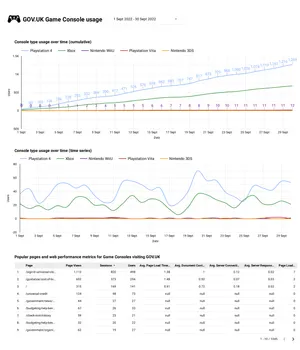
And this wasn’t a one-off occurrence, these statistics showed up month after month. This strongly suggested that a small number of users in the UK didn’t have access to a computer, or even a smartphone. They were resorting to a games console in order to access the internet to visit GOV.UK. Having used the PlayStation browser in the past, it’s not a particularly usable (or efficient) way to access the internet. But if it’s the only thing you have, then it’s certainly better than nothing! It’s reasonable to assume that many of these users may also be among the most vulnerable people in society.
In short, what is being described here is "digital poverty”.
What is Digital Poverty?
I wish there were a simple answer to this question, but there really isn’t. Digital poverty is complicated, deeply personal, and difficult to define neatly. So, let’s break it down and explore the different ways it can affect people’s lives.
Connectivity
If I were to guess, this would be the main category that people think about when digital poverty is mentioned. Access to a strong, stable connection is a vital part of modern life. As I’m sure many readers will know, it’s often only when your internet connection suddenly disappears that you realise just how much of everyday life depends on it. Work, banking, shopping, entertainment, communication, travel, and even accessing essential services can all grind to a halt surprisingly quickly.
We only need to look at a few published statistics to see how big of a problem connectivity is for certain demographics in the UK. According to the Ofcom Technology Tracker 2025 report, "5% of those aged 16+ in the UK live in a household where there is no internet access”, that’s approximately 2.8 million people!
And the UK actually has excellent connectivity with:
- 78% of UK premises can now receive full fibre broadband
- 87% of premises have access to gigabit-capable broadband
One major reason for digital poverty in this area is related to affordability, which has become increasingly worse given the ongoing cost of living crisis in the UK.
Households are having to prioritise living essentials like food, water, housing, and bills over internet connectivity. Ofcom reports that 26% of UK households reported struggling with the cost of telecoms services in 2025. This is a truly disastrous statistic, as there are safety nets in place to help with affordability. Millions of households across the UK could save around £200 every year through broadband social tariffs. But less than 10% of eligible households actually use a social tariff:
Millions are still missing out on superfast speeds for super low prices, with many not aware they even exist.
It has to be said that the UK’s connectivity challenge has shifted in the past few years. The question being asked is no longer whether “broadband is available”, but to whether “people can afford to connect”. While discounted broadband social tariffs could save many households around £200 a year, awareness remains remarkably low, meaning the people in most need often never benefit from the support available.
The impact of AI on connectivity
The impact of AI on connectivity has both pros and cons (as you’d expect from a pros and cons list…):
Pros
Let’s consider the pros that AI will have on connectivity. There’s the distinct possibility that network providers could use AI to predict network demand, fault-finding, and network outages. Rather than just waiting for these issues to occur at random, AI could be used to constantly monitor network traffic looking for signs of network issues and rectifying them in real-time, allowing for more stable connectivity for everyone. A research document from ScienceDirect: AI-Powered Resilience: A Dual-Approach for Outage Management in Dense Cellular Networks states that:
AI does not just rely on networks, it also improves them.
This network resilience is important for a user experiencing digital poverty, if their only connection to the internet is through their smartphone, and they have no fixed broadband connection to fall back on. It is their only lifeline to get to the digital information and services that they require.
AI could also help network operators make better use of their network capacity, allowing them to predict network traffic and allocate their finite resources depending on current demand. The Global System for Mobile Communications Association (GSMA) have already identified several opportunities for this technology:
AI network optimisation holds significant potential to improve energy efficiency of network operations.
These opportunities include: automated sleep modes, dynamic shutdown, load balancing, and traffic forecasting. This will be useful for areas where building additional networking infrastructure is expensive or simply not feasible due to location. As for its impact on digital poverty: it could potentially increase the quality and reliability of the connection without immediately requiring additional physical capacity.
Additionally, the use of AI could help governments and network providers identify areas of the country where more infrastructure investment is needed. By combining various data sources such as:
- existing coverage
- population
- demand
- network performance
The combination of this data could help more easily identify underserved communities and model where new infrastructure would have the greatest impact. This would have a giant positive impact on rural, remote, and low-income communities across the country. A report from the International Telecommunication Union (ITU) AI for Digital Infrastructure: Advancing Connectivity and Closing the Digital Divide, AI for Good 2026 mentions:
improving coverage mapping, network modelling, and understanding of demand, usage, and service quality.
In this case, AI is being used to suggest where additional network infrastructure investment should be made. This additional infrastructure could increase the availability of connectivity to remote areas across the country, and give more options to users living in digital poverty.
The use of AI in connectivity also has the potential to reduce costs, this can be achieved by operating more efficiently, automating maintenance, and making better infrastructure planning decisions. The ITU again identifies open networks where this optimisation would be helpful:
a strong potential to reduce Capital Expenditure (CAPEX) and Operational Expenditure (OPEX).
By reducing cost and providing higher-quality telecommunications services, it has the potential to reduce digital poverty in a similar way, that's assuming these cost savings are also passed onto the consumer! (Most likely not, but we can always hope).
Lastly, AI could help improve rural and satellite connectivity. These networks are complex systems where resources, routing, spectrum analysis, and connections between satellites and ground stations need to be continually managed, either via a human, or potentially AI. An article from Sciopen Artificial intelligence for satellite communication: A review quotes:
Satellite communication offers the prospect of service continuity over uncovered and under-covered areas, service ubiquity, and service scalability.
This is important because "service continuity”, "under-covered areas”, "service ubiquity”, and "service scalability” are all vital in combating digital poverty across the country.
Cons
Now let’s examine the cons.
In order for a user to take full advantage of AI they will require good connectivity. Much of current AI functionality is “cloud-based” i.e. it doesn’t run on a user's device. This is great for low-spec devices, but the downside is it requires a fast and stable connection. This isn’t always available for a user in digital poverty. The ITU describes the relationship clearly:
The transformative potential of Artificial Intelligence (AI) cannot be realized without comprehensive, resilient, and secure digital connectivity.
There’s a serious risk of creating another digital divide. Users with fast, reliable, and unlimited broadband will be able to make extensive use of all the functionality that cloud AI has to offer. While others without these resources will simply be left (further) behind.
Along a similar line, AI could also increase the negative effects of the connectivity divide that already exists in the UK. With AI being increasingly integrated into all aspects of society (e.g. education, employment, government, healthcare), having a poor connection is becoming more and more of a disadvantage. A warning from the ITU reports:
the advent of AI will only exacerbate its consequences.
Although this report isn’t specific to the UK, it includes the UK in its analysis. It’s important to realise that AI doesn’t need to make a user's connection worse to compound their digital poverty. It’s the fact that many in digital society are increasingly assuming that all users have extensive access to AI-powered services. Those without the means to access these services will not simply be left behind. They risk being pushed even further to the margins, deepening an existing disadvantage as the rest of society moves forward without them.
As you may already assume, the use of AI can increase network traffic. Although the impact of this is still uncertain, the Global System for Mobile Communications Association (GSMA) estimates that direct generative AI traffic currently represents only around 0.2% of mobile traffic, despite AI usage almost doubling over the previous year.
This doesn’t sound like a lot but future AI services may look vastly different. With an increase in AI-generated images and video, multimodel agents, and real-time voice services, plus any other advanced AI features that have yet to emerge. The GSMA identifies effects such as:
the generation and consumption of genAI videos, induced traffic from recommender algorithms, and the rise of agentic AI.
For a user with an unlimited and stable broadband connection this impact will be largely invisible, but it could have serious financial implications for users on limited data plans. In doing so, AI could present a new affordability barrier, one that goes far beyond actual payment for the AI services themselves!
Finally, any form of AI optimisation has a computational cost all of its own. There’s a real danger in assuming that using AI to make networks more efficient will automatically lead to overall cost savings. Researchers at the University of West London (UWL) found that:
the energy cost of AI techniques is often overlooked.
AI may help network providers save energy, bandwidth, and infrastructure capacity, but there’s a critical question: do those savings actually outweigh the cost of running the AI itself?
Ultimately, AI could make connectivity smarter, more resilient, and cheaper. But it could also make a good connection more essential than ever. If AI becomes part of everyday services without considering cost, data limits, or unreliable broadband, we risk turning an existing disadvantage into an even larger barrier for users in digital poverty!
Hardware & Devices
For me, the devices people use are the second-biggest factor in UK digital poverty, or more importantly the devices they depend on. This is a significant distinction because according to a USwitch report from August 2025 Smartphones have become the UK’s default computing device for accessing the internet. This is also reflected in Ofcom’s research, which now specifically tracks people who only go online using their smartphone. In terms of smartphone affordability, this is a crucial point. Assuming you’re a person who only uses a smartphone to get online, you’d hope that they have a modern device with high specifications. If not, that’s likely to be a real barrier to all the functionality and information the modern internet has to offer.
When it comes to device popularity in the UK, this USwitch report found a slight difference in smartphone preferences between men and women in 2024. Men were more likely to use Android devices than iPhones (51% vs 48%), while women were more likely to choose iPhones over Android (55% vs 44%). Interestingly, the same report also states that Android usage overtakes iOS in the older age groups, from age 44+ Android becomes more popular. This is interesting because iPhone devices are much more powerful across the whole cost spectrum. In May 2025, CatchMetrics wrote a blog post "Understanding the Impact of Low-End Android Devices on Web Performance". In the post they used real world Geekbench scores to compare high-end (i.e luxury) devices with low-end budget Android devices, and the CPU performance difference was gigantic to say the least! The latest iPhone at the time (iPhone 16 Pro) got a Geekbench Single Core of around 3400, whereas low-end Android devices like the Galaxy A24, and the Moto E14, struggled to get close to 1000! A striking quote they made:
The Moto E14 and Galaxy A24 score lower than the iPhone 6, released almost a decade earlier.
The critical issue here is that the use of JavaScript is increasing year-on-year, and JavaScript execution is almost entirely CPU bound. So a page that feels instant on a “luxury” iPhone device, could take seconds (or even minutes) on older spec devices, like older Androids. I have personal experience of this, I have a family member who isn’t particularly technology savvy. He bought himself a budget Android smartphone, then came to me asking why nothing would work. I looked at it and found it was so slow the Google Play Store app wouldn’t even load! If it couldn't load an app from its own storage and operating system, what chance would it have on the modern internet!
This is what is called the Performance Poverty Gap. Alex Russell has been talking about this issue for a number of years, in his 2022 blog post "The Global Baseline”, Alex sums it up very simply:
the web is increasingly designed by people using £1,000 phones for people using £150 phones.
Unfortunately, from what I’ve seen throughout my career, this is absolutely true. Web developers tend to be well paid and work with technology every day, so it’s hardly surprising that many use relatively powerful devices. The few developers I’ve seen regularly testing on low-spec Android devices are usually those involved in the Web Performance community, actively trying to highlight the massive bias we have towards testing on “luxury” hardware.
The impact of AI on Hardware & Devices
I actually believe AI’s impact on hardware and devices will be much bigger on hardware and devices than connectivity, so let's do some research and find out:
Pros
Cloud AI is becoming increasingly popular. This means that the bulk of the computing that AI needs is done remotely away from a user's device. Newer models like ChatGPT, Claude, and Gemini perform the heavy computation in the cloud. This means even an old smartphone can access cutting-edge AI simply through their web browser. If the AI were embedded into these devices it would simply be unusable. This is a quote from World Bank’s Digital Progress and Trends Report: Strengthening AI Foundations:
The transformative power of AI is fundamentally reliant on compute.
Modern AI can bridge some gaps in older hardware, making them more useful again. A user with an older laptop can now perform tasks using AI. For example:
- Summarising long web pages instead of loading multiple resources.
- Rewriting text rather than requiring specialist software installed that may be slow or simply unusable.
- AI assistants helping users navigate unfamiliar websites, again via the browser and AI computation on the site rather than the device.
In summary, AI allows an older device to perform tasks that once depended on numerous specialist applications, without needing them to actually be installed.
Next, let’s discuss how AI has the ability to consolidate many expensive devices into one. AbilityNet’s Robin Christopherson described needing a:
- £750 talking GPS
- £1,500 talking notetaker
- £250 talking MP3 player
- £100 talking barcode scanner
A modern smartphone with built-in AI could go even further than this, especially with the use of generative AI, making the need for other specialised equipment no longer required. Robin describes modern smartphones as:
all the power of computers with us wherever we go
Even though a modern iPhone costs £1000's it still works out cheaper than all the specialist equipment listed above. For someone experiencing digital poverty, this is still a significant expense. However, an AI-powered smartphone can offer one of the most affordable ways to access AI.
Moving on, smaller AI models are coming out all the time, these allow even modest devices to perform tasks that weren't within their capability when they were initially released. This could bring a significant improvement to on-device AI when using lower specification devices. One study found that techniques such as Quantized Low-Rank Adaptation (QLoRA) could cut peak fine-tuning Video Random Access Memory (VRAM) requirements by up to 3.9x.
compact Small Language Models (SLMs) paired with Parameter-Efficient Fine-Tuning (PEFT) provide a practical, energy-aware path to personalized on-device deployment
This means even older devices could receive future software updates that introduce new AI features. These features could bring significant improvements to a person in digital poverty, allowing them to use these features for various tasks including education, research, completing paperwork, and helping with potential job opportunities.
Cons
A major con for AI that runs on hardware is the significant requirements needed to run it, Apple (as they always do), have implemented AI limitations depending on the Apple device being used (i.e. forced obsolescence). Say if a user wanted to run Apple Intelligence on their iOS device, this requires at least an A17 Pro chipset, the earliest model that supports this chipset is the iPhone 15 Pro, the same limitations stand for iPad’s too. A user's device also requires 7 GB of free storage:
Apple Intelligence is not available on all iPhone models
This is a direct quote from Apple Support. So even when a user is running version 26 of their operating system, if the hardware doesn’t meet these requirements Apple Intelligence won’t be available to use.
I’m actually one of these users. I have an iPhone running iOS 26, but my model is an iPhone SE 2022 (2nd) edition. The reason I haven’t upgraded is because:
- it’s still perfectly usable as a device.
- the form factor actually easily fits in my pockets, even with an added phone case.
- It’s the last of the models that has a dedicated “home button”.
I’ve even spent £65 having Apple replace the battery in the past two months, specifically so I can keep using the phone for several more years!
In summary, AI is already creating a new hardware divide that users in digital poverty will really struggle to keep up with.
As already mentioned, AI can run both in the cloud and on a user's device. Unfortunately, there are limitations as to what cloud-based AI can do, especially for a user with an unstable and limited data connection. This means that on-device AI will need to be used for certain tasks. Research published on Arxiv repeatedly identifies hardware limitations when using local Large Language Model(LLM) deployments:
deploying and personalizing them on resource-constrained devices remains impractical due to high VRAM, time, and energy costs.
Some readers maybe asking where and why “Video” from VRAM comes into all this AI research?
Well, using a device’s dedicated Graphics Processing Unit (GPU) is preferable for AI because it contains thousands of processing units capable of performing mathematical calculations in parallel, potentially processing trillions of operations every second. This also leaves the CPU greater freedom to run the operating system and other background tasks.
Unfortunately, the use of cloud AI will only be able to take users in digital poverty so far. Should they ever want to take full advantage of all AI features, then they are going to need to invest in more capable (and expensive) hardware.
I’ve already mentioned a primary (and personal) example of how AI could make usable devices prematurely obsolete. My trusty old iPhone SE from 2022 is unable to run Apple Intelligence due to a lack of hardware requirements. It is a perfectly good device that I use for all other daily tasks, and I don’t intend to change it any time soon!
Thankfully, it is an iPhone, so it already offers a huge advantage over lower spec Android devices. I say this because in May 2025, CatchMetrics wrote a blog post called "Understanding the Impact of Low-End Android Devices on Web Performance". In the post they used real world Geekbench scores to compare high-end (luxury) devices versus low-end budget Android devices, and the CPU performance difference was gigantic. The latest iPhone at the time (iPhone 16 Pro) got a Geekbench Single Core of around 3400, whereas low-end Android devices like the Galaxy A24, and the Moto E14, struggled to get close to 1000! A striking quote they made:
The Moto E14 and Galaxy A24 score lower than the iPhone 6, released almost a decade earlier.
I’m genuinely grateful that I at least have an older iPhone. Someone experiencing digital poverty may not even have that luxury. They could be using a relatively modern, low-spec Android device that is still slower than an iPhone from a decade ago. If AI increasingly demands more from our devices, these users won’t just be a few years behind. They could find themselves effectively locked out altogether.
In summary, the benefits of local AI could become a privilege of expensive devices.
After all the positivity of the UK Government is actively encouraging organisations to refurbish and donate older devices to digitally excluded people:
refurbishing and donating end-of-life devices to people who are digitally excluded.
AI usage could be the main factor that stops this guidance in its tracks.
Assuming AI features require newer processors, large amounts of RAM, or dedicated AI hardware, there’s simply no way that older devices can cater for this requirement, even when refurbished.
There are literally billions of older devices collecting dust in people’s draws at home that digitally excluded people could easily use, but it is no longer about a user simply being able to access the internet. It’s about them being able to participate and achieve what they want to achieve online, and AI is increasingly becoming a barrier in this area.
While Cloud-based AI could bring computing power to older devices that was previously unimaginable. On-device AI could do the exact opposite, by creating a new hardware baseline that millions of perfectly functional devices simply cannot meet.
Affordability
Understandably in the current financial crisis of 2026, affordability of a “digital lifestyle" is a key concern for many households across the UK. It isn’t just about connectivity and hardware that have already been mentioned. Affordability comes with device ownership which also includes:
- repairs
- upgrades
- additional software
According to the Good Things Foundation Minimum Digital Living Standard (MDLS) 2025:
Meeting the MDLS is not a one-time expense but an ongoing financial commitment.
As anyone in technology knows, the whole sector moves incredibly fast, what is modern one month, can quickly become obsolete only a few months later! Households looking to meet the MDLS need devices that are secure, in working order, and also compatible with modern software and online services.
Now considering approximately 1.6 million UK households struggle to afford fixed broadband, how in the world are these households expected to maintain this digital standard of living? Households in this situation are often struggling to pay their broadband bill and have to prioritise essentials like food and housing over broadband, even if this limits their access to job opportunities, education, and social connections. Additional money for these added device ownership requirements, will very likely be way beyond their budget.
The above issue is further compounded once children are factored in to the household. As only 81% of UK households with children fully meet the MDLS. 81% sounds like a healthy percentage until you flip that figure, the other 19% of households in the UK don’t meet it, with 15% only partly meeting it, while 4% fall far below it.
I’ve recently experienced this myself as my eldest son turned 11 last year and moved from primary school (ages 4 to 11) to secondary school (ages 11 to 16). At primary school the internet was useful, but not essential.
This shifted completely once he started secondary school, he is now expected to submit most of his homework digitally via his laptop. Long gone are the days when you actually hand in your homework! This becomes a huge issue when schools can’t afford to provide laptops for all students, so households end up having to pay for these themselves.
Thankfully, I’m in the privileged position where I’m both technically savvy and can afford to purchase these devices when needed, but many aren't. As the MDLS briefing paper from 2025 states:
Households with children face increasing digital costs as children grow and require their own smartphones and data plans.
As you’d expect, as children grow, their digital requirements grow with them.
The impact of AI on Affordability
Having been paying for various AI-powered tools for a while now, I believe I have a pretty good idea of the answer to this question without any additional research. But for completeness I’ll dig into a few reports and see what the experts say.
Pros
There are actually surprisingly more Pros in this section that I initially expected.
According to Organisation for Economic Co-operation and Development (OECD) AI can extend the life of older devices, simply because most generative AI runs in the cloud, meaning users can access powerful AI capabilities without expensive local hardware, therefore allowing users on lower specification devices to access increasingly complex tools and AI workflows. It’s worth noting though that these users still struggle with AI that relies on local compute for AI. This mirrors what was said earlier in the post regarding hardware and devices.
In addition, the OECD also report that AI can reduce software costs, a single (cloud-based) AI assistant / Agent can replace multiple specialist software tools, like writing, coding, and image creation. By doing this they reduce the overall cost of ownership for users with these specialisms. Lastly, the OECD concludes that AI can increase productivity and earning potential for its users. For example, individual users or small businesses can complete work using AI that was previously out of their technical reach, due to the specialisms required to do the job(s):
Productivity gains are often found to be higher for low-skilled workers within specific occupations.
Another considerable pro of AI is that when used it can lower barriers to education and learning. The UK Government’s Department for Science, Innovation and Technology (DSIT), reports that AI can provide: personalised tutoring, explanations, translation, and writing assistance at little or no cost (compared to specialist tutors), making knowledge more accessible. Another fascinating statistic from the report is how AI free’s up peoples time:
45% of UK adults believe that AI frees up people’s time.
For households experiencing digital poverty, AI can reduce the amount of time spent on tasks that would otherwise require:
- understanding official letters
- budgeting
- writing CVs and job applications
- comparing utility costs to find the best deals
- translating documents
The DSIT survey also spoke to actual users of generative AI and questioned why they use it:
- 65% use AI to save time.
- 55% use it to generate ideas or inspiration.
- 48% use it to summarise or explain information.
These statistics are genuinely useful and informative because they reflect real-world user behaviour and not just perceptions. AI in education has huge potential for people experiencing digital poverty. It can save time, spark ideas, and make complex information easier to understand, all without requiring specialist knowledge or expertise.
Cons
While the OECD report mentioned a number of pros for digital poverty, the same can be said for cons. The primary and most obvious one being AI subscriptions. They create a new recurring cost, yet another monthly bill for households to worry about. Another digital expense alongside broadband and mobile contracts. Furthermore, the report states that as AI workloads increasingly depend on specialised AI compute, not all of this will be done in the cloud. So, some “on-device” computational resources will be required in order to take full advantage of certain AI tools.
This then goes back to the issue regarding low specification devices and many households being in a position where they can’t afford the latest devices. Older low-spec devices will always be disadvantaged when it comes to "on-device" AI, and the users of these devices will be included in this disadvantage too. The OECD highlights just how significant AI affordability can become in poorer economies:
Even the variable operational cost of AI models is extremely high relative to the mean GDP per capita in Low-Income Countries (LICs) and Lower-Middle-Income Countries (LMICs).
A compounding side effect of this for users is that as AI tools become more commonplace in industry and education. Those who can’t afford it won’t be able to meet the higher expectations from employers and society as a whole. The OECD Employment Outlook 2023 report states that:
The [report] results highlight the urgent need for policy action now, to ensure that no one is left behind.
As AI adoption is changing workplace requirements, workers who are "left behind" require policy support in order to address this ever-growing issue.
Lastly, and in my opinion most worryingly, I agree with what I quoted earlier in the post: simply having internet access may no longer be sufficient to participate in (digital) society in a meaningful way. The introduction of AI risks widening existing digital and productivity divides if adoption and knowledge barriers aren't urgently addressed.
Capability & Literacy
Next we come to making sure UK citizens have the practical skills, confidence, and understanding needed to use digital services effectively and safely. This is much easier said than done, but thankfully, charities like Good Things Foundation, have conducted a wealth of research and reporting over the years:
People need to update their skills as much as they need to update their devices.
As mentioned earlier digital poverty is no longer adequately described by whether someone has an internet connection. A user's capability to make full use of their internet connection is increasingly becoming a new barrier to entry for whole swathes of UK society. Ofcom’s 2026 Adults’ Media Use and Attitudes report states it plainly:
Being online does not necessarily mean full digital participation.
The Ofcom report found that:
- 20% of online adults rely solely on a smartphone.
- 21% are classified as "narrow internet users".
Narrow internet users are classed as a group associated with lower levels of digital confidence. The report concludes that digital exclusion isn’t simply shaped by a single metric like “connectivity”, it’s actually an intersection of barriers like device constraints, skills, confidence, as well as many other metrics.
In reality someone can technically be “online” while still experiencing digital poverty.
The impact of AI on (Digital) Capability & Literacy
As seemingly with all things AI there is an extensive set of pros, and sadly cons too.
Pros
First let’s examine the pros.
When it comes to integrating with technology, AI can lower the skill's barrier for everyday digital tasks. Natural language interfaces remove much of the technology knowledge needed to search the internet, navigate pages and complete online forms. If implemented correctly it has the potential to help users with lower digital confidence and help them participate in online tasks independently. A report published by DSIT and DCMS called AI Skills for Life and Work: summary report states that:
AI-powered technology is expected to become more user-friendly, lowering the ‘barrier’ to use.
Furthermore, AI can help support people with practical everyday tasks for example: explaining concepts in basic English, writing CV’s, understanding letters etc. The advantage of AI in this situation is it can quickly adapt its response to a users individual needs, literacy level, and provide immediate guidance without requiring formal training. Over time this can help build digital confidence simply by the user knowing that if they get stuck, they can ask AI as many questions as they require. A further advantage is the removal of potential embarrassment that comes with having to ask another person the same question multiple times. The Developing AI Literacy With People Who Have Low Or No Digital Skills report from Good Things Foundation has conducted research to back this up stating:
Giving people the opportunity to try AI tools themselves allows them to learn in a supported environment, ask questions, and discuss their experiences.
Lastly, and of significant importance to my work of the past 8 or so years. AI can make government services easier to understand.
There’s simply no getting away from the fact that some services come with complex eligibility rules, forms, and guidance. Not even the most simple and accessible User Interface (UI) can get around this content and user knowledge issue. Thankfully, AI has the potential to simplify these interactions and tailor them to an individual’s needs, making complex processes easier to understand and navigate.
This could particularly benefit people with lower literacy or confidence levels. A research paper from PLOS One, with an insanely long, but snappy title: "Improving citizen-government interactions with generative artificial intelligence: Novel human-computer interaction strategies for policy understanding through large language models", states:
Effective communication of government policies to citizens is crucial… yet challenges such as accessibility, complexity, and resource constraints obstruct this process.
The authors then conclude:
These results indicate the [AI] system’s efficacy in making policy information more accessible and understandable, thus enhancing public engagement.
So, to end this section on a positive note: AI has the potential to reduce the cognitive load for users of government services, using LLMs to provide clearer, plain language and personalised explanations at scale.
Cons
As you’d expect the cons are very much intertwined with the pros. GOV.UK’s "Digital Inclusion Action Plan: First Steps” policy report has a lot to say on the subject.
First, and likely most obvious is AI introduces a new layer of digital literacy. This new layer is actually a barrier to non-technical users:
The essential skills needed to participate in both economy and society are also evolving and increasingly include AI, media, and data literacy.
In order to solve this initial barrier, users are required to have foundational skills, and confidence in technology and the internet. As I mentioned earlier in the post: this is a multilayered problem as the report goes on to say:
Foundational digital literacy was identified as the most persistent and under-addressed barrier to inclusive AI up-skilling.
It’s very much a chicken-and-egg problem, in order to take advantage of AI a user classed as being in digital poverty, must already have the means and specialism to take advantage of it.
Unfortunately, AI can create fear and overwhelm in non-technical users.
If you have not got those basic level digital skills, AI is just causing a fear of overwhelm.
I, personally, think some of the “fear” comes from how AI has been portrayed in popular culture. For decades, we’ve been shown versions of AI that look a lot like Skynet in the Terminator film franchise: intelligent, autonomous, and usually not particularly fond of humanity.
Current AI is, thankfully, nothing like that. At its core, it uses vast amounts of information, statistics, and probability to identify patterns and generate a response based on a user’s input. Far less dramatic than Skynet, admittedly.
Still, once you’ve watched AI trigger a global nuclear war and attempt to wipe out humanity, a little apprehension is probably understandable.
Ofcom's Adults’ Media Use and Attitudes 2026 report has published statistics that suggest that many UK Adults confidence in accessing online information doesn’t match their ability, i.e. the classic Dunning-Kruger effect:
Adults’ confidence in assessing online information does not always match their ability.
The report later goes on to say:
14% of adults who said they were confident identifying scams failed to take the safest action in testing.
That’s a worrying statistic given how embedded "being online” is in modern society.
Online scammers are only getting better at what they do, and even the most tech-savvy users can fall for socially engineered online scams. This was seen in August 2022 when attackers sent SMS messages to 76 Cloudflare employees and some of their family members. The SMS claimed their work schedules had changed. It worked!
Three Cloudflare employees entered their usernames and passwords into the phishing site. Incredible really, considering how embedded Cloudflare is in global web security! I guess even technically savvy users can get drawn into these scams! So what hope does a user with very little digital literacy have?
On a similar vein, AI’s perceived ease of use can trip up inexperienced users as is reported in the UK government’s January 2026 "AI Skills for Life and Work” research paper:
This ease-of-use disguises risks to which the unwary user might fall foul.
And finally, the UK government admits that greater digitisation can increase exclusion, as reported in its Digital Inclusion Action Plan:
Increasing digitisation of public services without adequate skills provision risks limiting vulnerable groups’ access to the NHS, social care and social security support.
The National Health Service (NHS) is incredible, although I’m admittedly very biased! All working UK nationals contribute towards public services through taxes, including Income Tax and National Insurance, so it’s heartbreaking to think that some of the most vulnerable people in society may struggle to access NHS services simply because of digital poverty.
Accessibility and Inclusion
Accessibility and inclusion should be a vital consideration for all websites across the internet. Unfortunately, it is often overlooked and (sometimes) considered right at the end of a project, either because a developer has run a Lighthouse audit against the site, or a request from a client or organisation.
Thankfully, it is a requirement that all UK Government services meet WCAG 2.2 compliance. This isn’t just a “Nice to have”, it’s actually a legal requirement. In all honesty, there should be no need to enforce this requirement by law, it’s simply the right thing to do! Everyone should be able to access the information they need online, regardless of where they live, the connection they rely on, the device they can afford, or any physical or mental disability they may have. On the modern web this is called “Inclusive Design”. The Department for Education's (DfE) Accessibility Manual defines this as:
Inclusive design involves creating products and services that are accessible to, and usable by, as many people as possible without the need for adaptation.
As for inclusion the W3C have an excellent quotation:
The Web is fundamentally designed to work for all people, whatever their hardware, software, language, location, or ability.
This is from their excellent guidance on Introduction to Web Accessibility. Given the W3C’s status on the web, they really know what they are talking about. The World Wide Web Consortium (W3C) has played a fundamental role in shaping the Web we use today. Founded in 1994 by Web inventor Sir Tim Berners-Lee, it brings together organisations and experts from around the world to develop the open standards that allow websites, browsers, and devices to work together consistently. Its work also helps ensure that the Web remains accessible, international, secure, and open to everyone. As the W3C puts it, its mission is simple:
Making the web work - for everyone.
Sir Tim Berners-Lee commented on their impact back in 2023:
Today I am proud of the profound impact W3C has had.
So, if there’s one organisation that knows a thing or two about accessibility and inclusion on the Web, it’s the W3C.
The impact of AI on Accessibility and Inclusion
Pros
The aim for all government departments and their service teams should be to maximise accessibility by reducing barriers. Digital services should work for people with disabilities, language barriers, low literacy, cognitive differences, or other access needs. Thankfully, there’s research to show that AI could actually improve accessibility and inclusion.
Generative AI can translate complex information into plain English, clarify terminology, and adapt explanations to the individual asking the question. Just think how powerful this functionality could be for government services that involve benefits, healthcare, taxation, immigration, or justice. I’m pleased to write that the UK government already have ideas for AI’s usage in this area. The UK Government standards already have a well established requirement for accessible public services in the Service Manual. The Digital Inclusion Action Plan: First Steps policy paper reiterates this point:
Accessible public digital services means that individuals have access to essential digital services.
The report also states that these services should be written in plain English. This is where the power of AI and large language models (LLM) could change the way government services approach this requirement. Instead of publishing one simplified version for everyone, an AI interface could explain the same information differently depending on a specific user’s needs. Some example prompts users could use are:
"Explain this court letter using simple language."
Or even more specific and personal:
"I have dyslexia. Can you shorten this and highlight the important dates?"
Generative AI used in this way could significantly reduce the cognitive load on a user and essentially provide personalised easily readable content at a scale we’ve never seen before.
Moreover, AI could potentially help people with low literacy. For example, a user who is fine processing information in a simple human to human conversation, but struggles when it is presented in a dense written format. A research and analysis paper called AI Skills for Life and Work: Public dialogue published by DSIT and DCMS reports:
AI-powered tools can better accommodate diverse learning styles and needs, including for those with disabilities.
A citizen could essentially ask:
“What does this actually mean for me?”
So rather than a citizen needing to understand complex terminology, an AI could become the intermediary between complicated public-sector language and a citizen trying to understand it. This is another instance where AI is reducing cognitive load for the user and making government service easier to understand, and more inclusive.
Next it is fairly easy to see how AI could dramatically improve access for people with sight loss. The Royal National Institute of Blind People (RNIB) have published research on Sight loss and technology that concluded:
Artificial Intelligence (AI) driven technology is becoming increasingly accessible and can help bridge the gap in an inaccessible world.
Technology like computer vision that can describe images and recognise objects can help blind people navigate their surroundings. They specifically call out Microsoft’s Seeing AI, for its ability to help blind, and partially sighted people identify the world around them. One contributor of the research reported how AI-enabled smart glasses helped to identify ingredients on food packaging:
wearing the glasses means the tech scans exactly what I’m looking at.
Lastly, AI could reduce language barriers, this is incredibly influential for health services like the NHS who could use AI to maintain multi-language information. Modern multimodal AI potentially extends this to translation between written language, speech, and eventually even sign language and visual communication. The NHS’s Accessible information standard already requires that disabled people and those with communication needs:
can access and understand information about NHS and adult social care services.
The use of AI here could mean that language could become a preference, rather than a barrier.
Cons
Unfortunately, while the same technology that could reduce digital poverty, it can also make digital poverty worse.
AI could amplify existing discrimination, an AI system is only as good as the data it has been trained on via the developers, designers, and testers who worked on it. Should any part of that workflow / process be biased (or non-neutral) this could effortlessly be reflected in the responses it produces. The Information Commissioner’s Office (ICO) gives a clear warning in their "What about fairness, bias and discrimination?” guidance:
AI systems learn from data which may be unbalanced and/or reflect discrimination.
Thus:
may produce outputs which have discriminatory effects.
This also includes discriminatory outputs based on disability.
In fact, the Equality and Human Rights Commission give the same warning:
AI can perpetuate bias and discrimination when it’s implemented poorly.
In essence, accessibility failures could progress from primarily being UI issues and turn into AI and algorithmic ones.
An inaccessible UI may prevent someone from completing a form. A biased AI system may let them complete it, but produce a systematically incorrect outcome based on what its training data assumes about “people like them”. If this were the case, how would it even be detected? Furthermore, who would be the responsible party to fix it? It certainly would be magnitudes harder to fix than a simple UI change!
There’s also a danger that AI could introduce an "AI literacy gap”. This is where AI becomes another digital skill that users are expected to possess. The government explicitly recognises this in their AI Skills for Life and Work research:
basic digital skills are a prerequisite for AI literacy.
Ultimately, creating yet another barrier in the fight against digital poverty. So, the people who’d benefit most from asking AI to explain complex government services could simultaneously be the least confident about:
- what AI actually is
- how to ask AI a question
- is the answer correct
- how to spot a mistake
- if it is safe to provide AI the information
This is why recent (July 2026) government research highlights programmes specifically tailored to:
Addressing AI literacy gaps among digitally excluded individuals.
What was once a digital divide could swiftly become an AI divide.
Users capable of using AI receive faster, simpler, and more personalised access to information, while digitally excluded users are left even further behind.
Although AI could have an extremely positive impact on accessibility, the best of these AI features could quickly become premium and paid for functionality. In 2026, the UK government reported in its Public dialogue on AI Skills for Life and Work this exact concern:
Potential for increased educational inequality if advanced AI tools limited to premium/paid options.
And the principle applies far beyond education.
For example, we have two citizens:
Citizen A: owns a top of the range £1,000+ iPhone with built-in on-device AI, which can perform live translation, image understanding, intelligent voice control, document summarisation, as well as advanced accessibility features and functionality.
Citizen B: owns an old sub-£100 Android phone that barely runs a government service due to its poor specifications.
AI could therefore simultaneously improve accessibility for some, and make hardware poverty for others more pronounced.
In this situation, access to the best AI accessibility tools becomes yet another inequality based on a user's device capability, subscription cost, connectivity, and household income.
Next, we have AI’s remarkable ability to generate premium-grade bullshit (excuse my French!) and deliver it with absolute confidence. The reason I know this is that it has happened to me many times since using it. It will give you an answer that it is so confident about, a user wouldn’t even think about fact checking it.
I once asked AI about current frontend technology best practices and noticed it was relying on information from 2023. I eventually had to point out that it was 2025 and that its advice was outdated. Naturally, it responded with something along the lines of, “You are absolutely correct!”
Luckily, I knew enough about the subject to spot the mistake. But what if I didn’t? It’s clearly a significant enough risk that the UK Government explicitly advises users to evaluate AI output rather than simply accepting it as fact:
The people who most need AI to interpret information may also be the least able to verify whether its interpretation is correct.
This is quoted from the UK government’s AI Playbook and it stresses that generative AI outputs need appropriate human oversight and verification.
Government guidance also stresses that users should:
assess AI outputs for bias.
Finally, it’s important for users to understand that AI regularly just makes stuff up (i.e. hallucinations), this could be a real risk when it comes to using AI with healthcare, benefits, immigration, and justice services. As a hallucination within these areas of government could have a devastating impact on users, with real life consequences. The Playbook spells it out clearly:
Any generative AI services that output generated content directly to the public, for example, an LLM-powered chatbot giving advice on a government website, would be prone to hallucination and could lead to someone being misled about a government service, policy or point of law.
And later goes on to say:
In the worst case, hallucination could even lead to direct harm if a user acted on faulty advice. For example, a user being advised not to seek medical attention when they needed to.
This is why it is vital that the emerging AI divide be acknowledged and corrected quickly. Thankfully, there’s clear evidence referenced above that the UK government knows about this issue and is making plans to improve it, although whether the research and reports lead to actual results is yet to be seen!
Support
I firmly believe that access to the right support is key to enabling millions of people across the UK to participate fully in our digital society. A user could have a connection, a device, and basic digital skills, but that still doesn’t mean they can navigate the complexities of online society alone. Even with extensive access to AI a user will likely need help. Support in the context of digital poverty is defined as:
Access to trusted human help when technology, accounts, or digital processes become difficult.
This comes from the GOV.UK Service Manual guidance Assisted digital support: an introduction. The key word here is “trusted”. This trusted support can come from many places, whether that’s a friend, family member, local charity, library, church, or another trusted part of the community.
AI makes this support topic particularly interesting. It has the potential to provide support without relying on human interaction, but at what cost?
The impact of AI on Support
Pros
AI could improve support by giving users contextual assistance. Instead of having to interpret an error message via a help page or telephone to a support line, AI would interpret the error message for the user and point them in the right direction without any direct human interaction. GOV.UK already states that:
You must make sure everyone who needs your service can use it.
This is from their Assisted digital support: an introduction guidance in the Service Manual.
AI could actually offer 24-hour support where users would ask additional questions related to the service they are looking to successfully complete. For example:
- What does this mean?
- What document do I need?
- Why has this failed?
AI could provide immediate support for straightforward problems, with human support only stepping in when the AI cannot resolve the issue. Additionally, this support model could leave human support to concentrate on cases requiring further judgement or empathy (e.g. Register a Death).
AI also has the ability to sit as an abstraction layer between complex government systems and citizens. Having AI on hand to translate instructions into simpler language, explain terminology, and provide personalised guidance to citizens. This sits alongside existing GOV.UK guidance in the Designing assisted digital support in the Service Manual:
what’s stopping them from completing the service online independently.
The important point in the use of AI here is that citizens get stuck at different points in the service journey. AI allows this support to adapt in real-time to a users specific problem. This is a much better option than a FAQ (which GDS, really aren’t a fan of anyway!).
AI has the ability to help a user who struggles with literacy, terminology, confidence or just the unfamiliarity of the questions being asked. AI could rephrase the questions more naturally for the user depending on the criteria listed above.
When applied to digital support, AI has the potential to increase people's level of independence. Not only does good assisted digital support help with today's question, but it also increases the likelihood that a user will be able to answer questions and finish tasks on their own in the future.
AI used in this way could work extremely well, and if implemented correctly could provide seamless support, handholding a user through a service step-by-step. This comes with the added bonus of users being able to ask additional questions along the way. Thus giving a user all the information they need and more to complete a service journey.
The Good Things Foundation charity has research on this issue and it:
estimates that 8.5 million UK adults lack basic digital skills.
Users in this position are at serious risk of missing out on all the opportunities that AI offers. In the report it recommends that AI education should be delivered through community organisations and trained volunteers.
Now we come to how AI can help human support workers themselves. The person receiving AI support doesn’t need to be a citizen, it could be a library worker, Digital Champion, Citizens Advice volunteer, family member etc. These people could use AI to find guidance, translate terminology, or explain an unfamiliar process.
Again, the Good Things Foundation describes how valuable community organisations are as:
“hyperlocal, trusted relationships” with digitally excluded people.
The organisation also has a National Digital Inclusion Network which has local hubs. It describes these as:
trusted places providing informal digital support to people who are not online.
So rather than replacing those trusted human support workers, AI could actually increase what the support workers can help people with. This sounds like the best of both worlds!
Cons
The biggest risk is where organisations mistake AI support for human support.
Having encountered this on so many websites I genuinely understand this frustration. AI chatbots are cheaper and easier to scale than 24-hour human support. So organisations have taken it on themselves to replace in-person, and telephone support with an AI-driven chatbots. As I’m sure many readers will acknowledge, these AI chatbots often aren’t particularly helpful. In fact, they can become another barrier entirely, creating frustration for everyone, not just those with lower levels of technical literacy. GOV.UK guidance specifically quotes that:
Not all users who require support to use a digital service have the same needs.
Unfortunately, AI chatbots don’t understand this. They lack the empathy and the drive to actually solve a users issue. It’s important for all organisations (not just government services), that just because a website has a chatbot with a “help” button, it doesn’t automatically fulfil the above guidance.
There’s a real danger that AI in the support space becomes a justification for cutting telephone and face-to-face services. That would be a terrible outcome for everyone, but particularly for older people and anyone who simply needs or prefers support from another human being, regardless of their level of technical literacy.
There’s also an absurd circular assumption here too:
“Can’t use our digital service? Why not try our digital AI service for help using our digital service?”
It really doesn’t work does it…
Another key concern is user trust. GOV.UK already recognises a lack of trust or confidence in digital services as one reason why someone may need additional support.
Additionally, AI introduces another layer of uncertainty for a non-technical user.
Research from the Ada Lovelace Institute and Alan Turing Institute’s nationally representative 2025 survey found that:
67% of the UK public had encountered some form of AI-related harm at least a few times.
This included false information, financial fraud, and deepfakes.
The same study also found that responders to the survey also expressed concern about the over-reliance on technology, potential mistakes it could make and a lack of transparency in its decision-making.
For a user who already mistrusts technology and online systems, being told they are talking to an AI will very likely to increase their anxiety.
The key to effective support is to establish trust. It is very difficult, if not impossible, for AI to do this simply by answering questions. In many situations, a recognised human e.g. from a library, council, charity, NHS organisation, or government department will carry considerably more trust than an AI assistant ever will.
It’s also incredibly important that people have a way to escape automation, this is especially true when it comes to AI decision-making. The Ada Lovelace Institute and Alan Turing Institute found that:
65% of people said having procedures for appealing AI decisions would make them more comfortable with AI.
This in itself points to a key design decision that should be implemented everywhere when using AI for support:
There must always be somewhere to go when the machine cannot help.
I’ve personally encountered this issue so many times, as I’m sure many readers have too, where all you want to do is “speak to a person”.
Organisations are rapidly funnelling their users through AI support systems on the web and telephone too, making the speaking to a person increasingly more difficult.
If a public service decides to use AI as a primary support channel, there should absolutely be a requirement for a “speak to a person” option somewhere in the user journey. This would act as a “fallback” should the AI not understand the user and vice versa.
Lastly, AI literacy itself could create a new digital divide. Ofcom reported that AI adoption is growing rapidly:
ChatGPT alone received 1.8 billion UK visits during the first eight months of 2025, compared with 368 million during the equivalent period in 2024.
Yet, the Good Things Foundation estimates that 8.5 million adults still lack basic digital skills.
This creates a divide between those who can use, question, verify, and challenge AI, and the millions across the UK who cannot.
In essence, AI will not remove the need for traditional human support. For millions of users, the trust and digital skills simply aren’t there. In fact, AI is creating a whole new category of digital support. We now expect less technically literate users to know when AI should be trusted, questioned, verified, or simply ignored. But who teaches them how to make those judgements? Without trusted human support, we risk expecting people to navigate AI safely before anyone has helped them learn how.
Where this digital support comes from truly matters. The Service Manuals Assisted digital support: an introduction guidance states:
AI should be the first line of support where appropriate, not the last remaining way to reach a service.
This is a very similar stance to Progressive Enhancement in Frontend development:
AI can enhance the support model, but the underlying human route should continue to work without it.
Here, we are effectively comparing AI to JavaScript. If JavaScript fails, is disabled, or simply does not load, the underlying service should remain usable, allowing the user to complete whatever they came to do.
The same principle should apply to AI. If a user cannot use AI, does not understand it, does not trust it, or the AI simply cannot solve their problem, the underlying human support route should still be there. AI should progressively enhance support, not become a prerequisite for accessing it.
As we move into this new AI world, I believe this should become a fundamental service design principle: AI should enhance a service, never become the only way to access it.
Safety and Trust
With online scams so widely reported, it’s understandable that many less technically confident people are fearful of going online at all. A report from the charity Age UK published its Scams Prevention and Support Programme research found that from their survey of over 10,000 UK adults over 50 that:
a fear of scams … prevents 7% to 8% from using the internet and smartphones, respectively.
The report later quantifies that number as being approximately 1.8 million over-50s being prevented from using the internet because they fear scams, and 2.1 million being prevented from using smartphones. Another AGE UK report states:
21% of respondents said that one of the reasons they are reluctant to do online banking or shop online is the risk of being scammed or defrauded.
To be clear, I’m not suggesting that everyone over 50 in the UK experiences digital poverty because they lack money. However, a significant number may experience it in another form: lacking the skills, knowledge, or confidence needed to participate fully in an increasingly digital society.
The charity Re-engage published a report The unseen price of a scam: The impact of scams and fraud on isolated older people. The direct quotes from older UK citizens, makes for a troubling read:
I think possibly that I haven’t gone online because there’s so many complications. You know, pop ups, and cookies, and scams, and all sorts of things like that.
The report concludes that:
fear of scams makes older people less likely to use technologies that could improve their lives, including the internet, email, and online banking.
It’s appalling to think that there are millions of older people across the UK won’t engage with online services because of a fear of being scammed.
I have seen first-hand how quickly a scam can destroy someone’s trust in technology.
My uncle, who is over 70 and relatively new to using a laptop, received a call from someone claiming to be “Microsoft support”. Unaware of the risks, he gave them remote access to his computer. After keeping him on the phone for more than three hours, the scammer eventually deleted critical Windows files when he refused to cooperate further, leaving the laptop unable to boot.
The financial damage was avoided, but the impact went much further. The experience destroyed his confidence in using the internet, and he now avoids important online services because he is frightened of being potentially scammed again.
Thankfully, he has family who can help him when he needs to do something online. Many people do not have that support. For them, fear of being scammed can become yet another form of digital exclusion, cutting them off from services and opportunities that increasingly assume everyone is willing and able to participate online.
Here’s another example regarding online trust:
I recently spoke to a colleague working on the Money and Pensions Service (MaPS), who highlighted an insightful barrier around trust.
The service is accessible, performant, and well-designed. But when users need to access sensitive pension information, they must first prove their identity through GOV.UK One Login.
Technically, the process is straightforward, particularly on a smartphone where users can easily photograph their ID. The biggest barrier is convincing citizens that it is safe to do so.
For someone who is less confident online, being asked to photograph their passport or driving licence and upload it can look remarkably similar to the very behaviour they have repeatedly been warned to avoid. With online scams so prevalent, their hesitation is not only understandable, it is entirely rational.
Even I felt a degree of hesitation when going through the One Login process myself. We spend years telling people to protect their personal information and be extremely cautious about sharing it online, then a legitimate government service asks them to photograph and upload some of their most sensitive identity documents.
The key takeaway is: a service can be secure, accessible, and technically excellent, but if people do not trust it, they may still be digitally excluded.
The impact of AI on Safety and Trust
Pros
While not at all citizen focussed, AI is incredibly useful for detecting scams, fraud, and harmful content on the web. AI isn’t only a tool for scammers, the same tools can be used defensively against suspicious behaviour, fraudulent content, impersonation, deepfakes, and other threats at scale. Due to the amount of content on the modern web, human moderation is simply impossible, but if AI is used together with human moderation, it becomes a powerful combination for combating misuse across the web.
Ofcom specifically recommends automation alongside human review in their A deep dive into deepfakes that demean, defraud and disinform report.
Thankfully, work has already started on including safety recommendations of deepfakes and disinformation into the UK online Safety Act. Only this year (May '26), Ofcom recommended the use of automated hash-matching technology to prevent the redistribution of illegal intimate images, including explicit deepfakes.
Online platforms can use automated and human-led content reviews to help distinguish real from fake content.
A citizen with limited digital skills shouldn’t need to become a cybersecurity expert simply to participate online. AI has the potential to shift more of that burden away from the individual and onto the platforms and services that are better equipped to manage it.
Moreover, AI could act as a second pair of eyes, helping users assess whether something online can be trusted. A user could ask an AI assistant to examine a suspicious email or website, explain an unfamiliar security warning, or highlight signs that something might be a scam.
This would be extremely valuable for users who don’t have immediate access to a technically confident friend or family member.
Ofcom has also helped trigger a wider design opportunity here, where AI services are forced to embed digital watermarking into any AI-generated content as a way of helping people understand where digital content originated and whether it has been manipulated.
In Ofcom's report How can tech firms help users spot deepfakes? It quotes that:
85% of adults support platforms attaching AI labels to content, yet only 34% say they have actually seen one.
This suggests that users actively want more assistance establishing what they can and can't trust online.
For government services the use of AI could have a positive effect of making services more transparent. If well-designed and integrated into a service, an AI could help explain complex processes and decisions in plain language. This includes what information was considered, why the decision was reached, what the next steps are for a user, and what happens next.
There is a clear link between transparency and user trust, and the UK Government’s AI Playbook directly identifies this:
A lack of transparency can lead to: harmful outcomes, public distrust, a lack of accountability and the ability to appeal.
It also emphasises that service teams should:
Explain your system in plain English.
From a digital poverty perspective, when used correctly AI could reduce the knowledge gap between people who understand how government systems work and those who don’t. It’s important to realise that this can only happen if the output from AI is trustworthy, reliable, and the user can challenge the underlying decision.
As mentioned earlier in the post, AI assisted decision-making is a powerful tool that could help government departments triage, detect problems, and highlight unusual behaviour with any applications they receive. While the final decision from any service should always include human insight. Rather than an AI-only model, this moves to an AI-assisted model. The AI Playbook explicitly warns:
AI should not be used on its own in high-risk areas which could cause harm to someone’s health, safety, fundamental rights or the environment.
Research from DSIT made similar recommendations for AI business adoption of AI:
Safe AI usage must involve human oversight.
This feeds back into the support section I wrote earlier in the post. AI can easily extend the amount of help available to citizens, but it shouldn’t be used as an excuse to remove the human safety net from checking the accuracy of an AI’s responses.
Cons
Unfortunately, as AI has become more widely available, criminals have also found plenty of ways to use it for malicious purposes. In doing so, AI can dramatically lower the barrier for sophisticated scams. Generative AI allows scammers to generate more convincing emails, websites, voices, images, videos, and conversations cheaply and at an unprecedented scale. Scams that previously required specialist technical ability and a proficient understanding of the intricacies of the English language, can now be increasingly automated.
DSIT’s research paper Safety and security risks of generative artificial intelligence to 2025 (Annex B) puts it very bluntly:
The rapid proliferation and increasing accessibility of these technologies will almost certainly enable less-sophisticated threat actors to conduct previously unattainable attacks.
It later goes on to report that AI is likely to amplify existing threats, and most certainly create entirely new ones.
Unfortunately, the digital poverty implication is that the people who are least equipped to recognise conventional scams may now face much more convincing ones.
Ultimately, over the long-term there’s going to be an erosion of trust as “seeing is believing” is no longer a convincing argument. An Ofcom report found that:
43% of UK people aged 16+ reported seeing a deepfake during the previous six months, yet fewer than one in ten, 9%, were confident that they could identify one.
AI used in this way is creating a much more profound trust problem, one that digital literacy alone may no longer be enough to solve. When convincing scams, impersonation, and misinformation can be generated at scale, even confident and experienced internet users can struggle to tell what is real.
The simple advice to:
Check whether the person looks or sounds genuine.
Can no longer be taught, since a cloned voice of their child, family member or friend may genuinely sound like them.
Furthermore, it will no longer be enough to spot imperfect grammar in fraudulent messages that contain accurate personal information.
Deepfakes that defraud… can be used in fake adverts and romance scams.
This is the summary that Ofcom sets out at the end of their report.
It is already challenging to help people with lower digital skills build trust in online society. AI risks making that issue far worse. The danger is no longer simply that someone might believe something fake. It is that, eventually, they may stop believing anything online at all! The DSIT report Safety and security risks of generative artificial intelligence to 2025 (Annex B) warns of:
Erosion of trust in information.
And later goes on to say that fake media risks:
eroding public trust in government.
This will have a devastating impact for digital poverty, a citizen who already lacks confidence online may respond to an increasingly confusing environment by withdrawing from it entirely.
The impact of this on the individual would mean avoiding life critical services like online banking, government services, healthcare portals, online payments, or digital communications, even when they are genuine.
I touched on this earlier in the post AI itself can confidently provide incorrect information, it has an excellent ability to make information up in a very convincing way! A new digital skill that people need online is how to filter out the false information from the trustworthy information. Another DSIT survey reports:
74% of UK adults identify inaccurate information as a concern about AI, making it the most commonly perceived AI risk.
It’s not only individuals, Businesses show the same concern:
Many businesses felt a major risk using AI was that they could not guarantee the accuracy of outputs.
For a government service, this is particularly dangerous. AI could generate authoritative-sounding but incorrect information about benefits, court proceedings, immigration, tax, or healthcare. For citizens who trust that information and act on it, the consequences could be life changing. In these situations, it is far better for AI to admit that it does not know the answer rather than to confidently make one up.
Lastly, on the subject of trust, it could become another form of digital inequality.
Users with higher digital skills will be in the position to learn new behaviours like verifying sources, recognising AI-generated content, cross-referencing information, and spotting a hallucination (made up content). Others may not.
In this scenario AI will create a new digital skills divide based around verification and trust.
Limited understanding directly affects trust:
Businesses that were not using AI were more likely to express a lack of trust, and this was often due to a limited understanding of AI.
Although this government research focused on businesses, it’s not a leap to see how someone with a deeper understanding of AI may be better equipped to calibrate their trust. Knowing when to rely on its output, when to question it, and when to verify it elsewhere.
Unfortunately, the overarching conclusion of this safety and trust section is: AI could make the internet safer while simultaneously making it harder for people to know what is safe.
Agency and Outcomes
Digital poverty is evolving, it used to be as simple as “Can a user get online?” it has now progressed to "Can a user get online, and actually accomplish what they came online to do?”. AI has a big part to play in this. The British Academy describes this as:
the third level of the digital divide.
This is where inequality impacts a person's ability to turn online resources into “beneficial social benefits”.
Whether people can actually achieve what they need digitally, rather than simply having access in theory. Another quote from the British Academy cites the Digital Poverty Alliance’s definition digital poverty:
the inability to interact with the online world fully, when, where, and how an individual needs to.
What is meant by Agency and Outcomes? A person may have all the equipment they need to interact online:
- a smartphone
- ample mobile data
- reasonable digital skills
Yet the person could still experience digital poverty.
There are a number of examples of this:
- They can get to an online benefits service like Universal Credit, but then are unable to understand what evidence they need to provide in order to progress their claim.
- They are able to get to a General Practitioner's (GP) online portal, or NHS service but fail to be able to book an appointment.
- They can access housing services but cannot proceed without proving their identity (an identical issue to the GOV.UK One Login Example I gave earlier in the post).
- They understand individual government guidance pages, but struggle to identify which of several services is the right one for their needs.
Citizens Advice provide an excellent example of this:
we help people every day who are locked out of benefits portals, unable to prove their visa status or struggling to secure housing online.
That is "Access without Agency". The person has everything they need to get online, and technically, they are connected, but the outcome they came online to achieve remains unreachable.
The UK Government’s 2025 Digital Inclusion Action Plan estimates that:
23% of the UK population may struggle to interact with online services.
The action plan later goes on to say digitally excluded people are likely to:
- have fewer employment opportunities
- pay more for transactions
- experience worse health outcomes
- find managing money harder
Let’s examine what online research says about AI in this scenario.
The impact of AI on Agency and Outcomes
Pros
A huge potential win in terms of outcomes for AI are its ability to reduce cognitive load. It could genuinely help users navigate complex digital services. The Competition & Markets Authority (CMA) reported in their Agentic AI and consumers research paper:
AI agents could save people time, and reduce cognitive load.
Just imagine the impact this could have on digital poverty if a user could describe what they are trying to achieve to an AI in plain English and the AI can help them navigate the complex terminology, processes, or service structures.
AI could help people who are unsure what they need to do next, as mentioned earlier in the post, just because a user has access to the information, it doesn’t mean they know how to act on that information. In a blog post GDS posted recently, they state:
Participants said that GOV.UK Chat’s answers helped them decide what to do next.
AI used in this way could help bridge the gap between simply finding information and being able to act on it, making it easier for users to achieve the outcome they actually came online for.
Another use for AI could be for delegating outcomes. Rather than simply explaining information for a user it could actually perform tasks for them too. In another quote from the CMA’s report:
consumers could potentially move from using tools to delegating outcomes.
In this case, a user may not even require the digital skills, the AI would be given a goal to achieve by the user and it works out the best way to complete it for them.
We’ve already discussed how some people depend on friends, family members, or support workers to help them complete online tasks. The downside to this is people can find asking for help embarrassing and it robs them of their independence. A report from the House of Lords states as follows:
give people with learning disabilities more control and agency.
The use of AI could give a user independence and privacy that is lost when asking for someone else’s help.
Lastly, AI could make specialist services more accessible. Specialist advice in law, finance, tax, and government, is often costly. This is prohibitive for a user in digital poverty. AI could lower the expertise and financial barriers allowing people to access the information without this heavy financial burden:
easier to access and more affordable.
This quote is from another House of Lords report on AI and the Justice system. In summary AI could give people access to information that would otherwise be difficult or expensive for them to obtain.
Cons
As I’m sure you’re now used to (if you’ve managed to get this far into the post!), where there are pros there are also cons.
For users wanting a specific outcome, AI could unfortunately lead people towards the wrong solution. This is probably the biggest risk when it to comes to AI moving away from just giving users information and moving to influencing user actions:
Fundamentally, generative AI models cannot be trusted to produce factual content.
This is a quote from the UK government’s AI Playbook. The implication is that users with lower digital skills and literacy may be less equipped to recognise incorrect advice, question it, or independently verify whether it is accurate.
When it comes AI influencing user actions, rather than just providing information, any mistakes have real-world consequences.
When agents act autonomously, any errors in performance could have costly real-world consequences.
This reference is from Agentic AI and consumers from the CMA. Under these circumstances, AI advice may not just confuse users. If AI is also able to act on their behalf that confusion could have real consequences. It could submit an application, make a purchase, cancel a service, or change important information without the user fully understanding what has happened, why it happened, or how to undo it.
Furthermore, over-reliance on AI is a real risk, and it is to the detriment of the user. It’s counterintuitive, but AI could allow users to achieve more while leaving them with less understanding and control. The same CMA report quotes:
there is a risk of over-reliance.
The use of AI could leave users dependent on it, leaving them unable to scrutinise its recommendations or intervene when something goes wrong.
For users to have genuine agency when using AI, they need to understand its outputs, question them, and challenge the outcomes when something does not seem right:
Opaque decision making can make it harder for consumers to understand, challenge or seek redress for unfair outcomes.
This quote is from the Agentic AI and consumers research by the CMA. AAs mentioned earlier in this post, the implications become especially serious when AI influences outcomes related to benefits, housing, employment, finance, immigration, or justice. In these areas, an incorrect or misunderstood outcome is not simply an inconvenience. It could have a significant and lasting impact on someone’s life.
Finally, as indicated earlier in the post AI could create yet another digital divide. As AI becomes increasingly important to achieving good digital outcomes, there is a real risk that the existing digital divide will widen rather than narrow:
without taking steps to address the existing digital divide, AI could widen it further.
This quote is from the AI Skills for Life and Work: Delphi Study by DSIT and DCMS UK government departments.
The impact on digital poverty is clear: people with good access to AI and the skills to use it effectively gain yet another significant advantage, while those already struggling to participate in digital society risk being left even further behind.
Summary
As you can see, there’s a lot to digital poverty! It’s a multidimensional issue, I’d love to say that AI changes this. Unfortunately, in many ways, it could make the divide even worse. My main takeaway from all the research above is that users lacking digital skills will be increasingly left behind over the coming years and decades.
AI is developing at such an incredible pace, even the very technically literate are struggling to keep pace! Nothing says this more than a quote from Andrej Karpathy:
I’ve never felt this much behind as a programmer.
Now given Andrej worked at OpenAI and led AI at Tesla, what hope do the rest of us have? I find that quote genuinely striking, and, if I’m honest, more than a little frightening. I’m fully aware of the Dunning-Kruger effect, and perhaps more importantly, I’m very aware of just how much I still don’t understand about this multi-billion pound industry.
I genuinely hope that government programmes, charities, and other educational initiatives can bridge this gap before millions more people are left behind and digital poverty deepens further. AI has enormous potential to make the digital world more accessible, understandable, and useful, but that potential will only be realised if everyone has the opportunity to benefit from it.
As AI technology develops at an extraordinary pace, we need to ensure that support, education, and inclusive services develop alongside it. Otherwise, AI risks accelerating existing inequalities rather than helping to remove them.
If I were to sum up this entire post in a single sentence, it would be this:
The true measure of AI progress will not be how far the technology advances, but how many people are able to advance with it.
As always, thanks for reading. If you’ve made it this far, congratulations. You’ve successfully reached the end of what turned out to be a rather longer post than originally planned!
I hope you enjoyed reading it as much as I enjoyed writing it. Feedback, thoughts, corrections, and ideas are always welcome, so please let me know. I’ll happily add any contributions to the post changelog below.
AI usage disclosure
I want to be fully transparent about how I used AI while writing this post. I used ChatGPT for specific, targeted tasks: researching particular topics, finding relevant evidence and quotes, and helping me refine my own thoughts into clearer, more succinct language.
The arguments, personal experiences, opinions, and conclusions are my own. AI helped me research, challenge, and communicate those ideas, but it did not decide what I think.
Given that this post explores the impact of AI itself, it felt particularly appropriate to use AI as a tool while writing it.
Post changelog:
- 06/09/26: Initial post published.